

Himalaya 2014
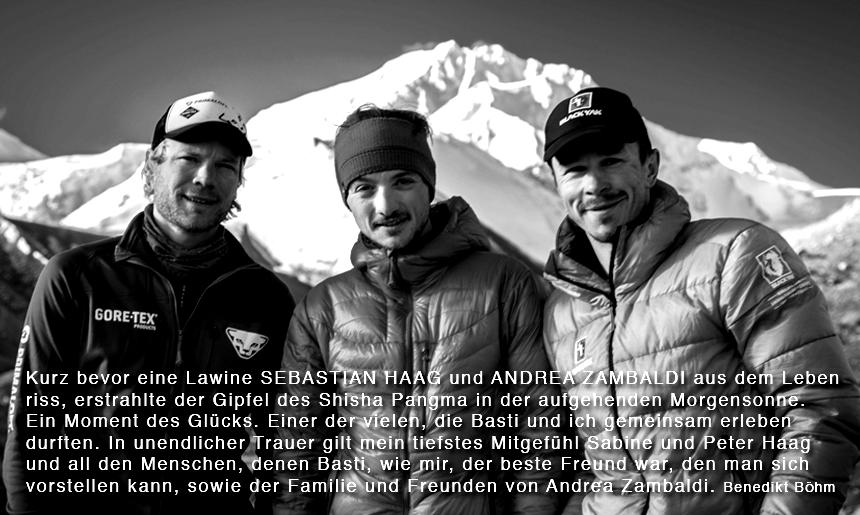
On 19 August 2014, Sebastian Haag and I set off on another skiing expedition to the Himalayas. This time, we weren’t just planning to climb one 8,000-metre peak, but two. The aim was to summit both Shishapangma (8,013 m) and Cho Oyu (8,201 m) on skis in speed-style within just seven days. Furthermore, the route between the summits’ base camps was to be covered exclusively ‘by fair means’ – by mountain bike or on foot. An endeavour at high altitude throughout and without artificial oxygen.
The idea of climbing two eight-thousanders in succession isn’t as crazy as it might sound. Others have done it before, and it actually makes sense. Once acclimatised to the altitude, the physical effort required to tackle a second eight-thousander is considerably less.
But it was not to come to that.
Sebastian Haag and Andrea Zambaldi lost their lives in an avalanche on 24 September 2014. A part of me died with them.
…
I often go to the mountains. I now stand alone on many of the peaks that Basti and I once climbed together. It is my way of keeping him close, of mourning him, of remembering him and our time together with deep gratitude.
Book excerpt: Summit Codes
Read more Show less
Before the ascent we had discussed whether to start our speed ascent at base camp as usual, or at Camp 2. Basti wanted to start at Camp 2 and I encouraged him in that. I knew that he – unlike me – was able to recover well at altitude. Because of a cold and his experiences on Broad Peak and Manaslu, he rated his chances higher if he split the ascent. I still wanted to start from base camp, because nights at high altitude weaken me considerably. In the past we had often handled it this way: we would start from below and pick up friends at the higher camps in order to continue together.
On this ascent, Martin and Andrea had decided to make their summit attempt from Camp 3. Basti was irritated by my decision not to accompany him to Camp 2 straight away, and he voiced the concern that not starting from base camp could be interpreted as weakness. On top of that, Ueli Steck had decided to set off from below with me, which reinforced Basti's feeling of being sidelined. In this emotional state he in effect gave an emotional interview. This interview was later published out of context and construed as a sign of disloyalty on my part.
Basti and I had been friends since we were eleven years old. We shared everything with one another and came to know each other far beyond the mountains, right down to the depths of our souls. Part of our friendship was that we could also settle differing views emotionally at times, especially in tense situations like this one. I assured him that it made absolutely no difference who started at which camp and that we were in any case on the move together as a team. For me it was a sign of strength and of important development that Basti had chosen his own path, the better one for him, via Camp 2. When Ueli and I picked him up at Camp 2 on the day of the summit ascent, Basti and I embraced firmly and assured each other that the matter was settled and that nothing stood between us. For me this episode was an ordinary blip in a friendship that had grown over more than 25 years, and normally not worth mentioning. All the more it has affected me that a picture is being conveyed in hindsight that does not do justice to our friendship and our mutual affection.
A radio message I sent immediately after the accident was also later portrayed misleadingly. In it I asked that no media be informed. This request served solely to protect the relatives. During the major accident on Manaslu in 2012 we experienced for ourselves how distressing it is when families first learn of such events through the media – often incompletely, and therefore in dreadful uncertainty as to whether something has happened to their loved ones. It was very important to me to inform the relatives personally and reliably, which is what I did. This thought was the only motivation behind that statement.
During the ascent we were troubled by very demanding conditions. We fought with the snow conditions all night, until at sunrise we were on the summit ridge and saw the summit ahead of us. In our minds we were already on the summit, because it was not far now. The hardest part lay behind us. And then, as if out of nowhere, Basti and Andrea were torn from life. An avalanche pulled Basti and Andrea 600 metres into the depths and to their deaths. Martin was swept along as well, but survived the fall and was able to save himself. Ueli and I survived only by luck. That day changed my entire life. It remains seared in as a great wound with a scar that will never heal. Basti was one of the people who shaped me deeply. He had an incredibly infectious manner, was a powerful doer and at the same time a very good soul. I shared the most intense time of my life with him. A part of me died with him, and not a day has passed since without a thought of him.
It was a rupture without equal for me, one I was not prepared for, no matter how much I had already been through. It was the worst time of my life. Today I can understand that after experiences like mine on Shishapangma, people eventually see no way out. When you cannot manage to stop churning up what happened again and again, and keep asking yourself: »Should I have done that? Should I not have left that alone? What would have happened if …?« These self-reproaches and the endless brooding can wear you down completely inside. That is how it was for me too. But at some point I consciously decided to take up my life again and to free myself from the endless loop of my self-destructive thoughts. To acknowledge, full of emotion, that the accident had happened, that nothing would bring Basti and Andrea back and undo it. I had to regain control over my thoughts and my life in order to be able to carry on. Alongside the conscious decision that life goes on, during that time I concentrated very strongly on my family, my siblings and my base, and otherwise withdrew.
That was a hard time. An enormous additional burden were the reproaches and accusations from outside that I found myself confronted with. I had to learn to endure and accept criticism without losing myself in confrontations – I had no strength for that and would have broken inwardly. After the accident I was not capable of acting in the classic sense. I functioned on autopilot – but in a certain way I was not in my right mind.
In retrospect I know that I was severely traumatised and would have needed help. Not only to process what had happened and to hand over decisions, but to protect myself from myself: from premature interviews given under the influence of an impaired perception that was due to the state of shock as well as to the extreme physical and psychological strain and the massive lack of oxygen in the death zone. From the impulse to want to explain everything while I myself was still in a state of emergency. In that moment I would have needed someone standing between me and the public, someone who filters, protects and regulates. Shock is a biological emergency response. During a traumatic situation, memory formation is often limited and fragmented; memories are not stored completely but reconstructed later, which can lead to blurring, differing perceptions and distortions. After a traumatic event the body switches into survival mode: perception narrows, the sense of time becomes distorted, emotions can be blunted or overwhelming. Decisions, words and assessments are often not reliable at this stage1.
That is precisely why it is so dangerous in dealing with the public, with expectations and with pressure from outside. The journalistic code of ethics also states that people in a state of shock are considered particularly in need of protection, and it calls for restraint, distance and respect – protection from the public takes precedence over speed and sensation2. In my case this trauma-shaped state, in which I did function but was not really with myself inwardly, lasted several months. During that time I encountered very sensitive journalists, and most of them held back respectfully. At the same time, however, I also encountered some who demanded statements and wanted a story at any price. This ethically questionable interview practice is also called »widow bashing«. In journalism, »widow bashing« denotes a practice perceived as insensitive or intrusive, in which the bereaved are aggressively questioned, emotionally exposed or instrumentalised for media dramatisation in order to increase attention and reach.3 With what I know today about trauma, memory formation in extreme situations and post-traumatic stress, I know that I should have refused these demands.
That I nevertheless allowed myself to be persuaded into interviews is something I deeply regret, because the statements made in this traumatised state of shock subsequently led to irritation and hurt people – for which I am very sorry. In my distorted perception I had said in early interviews that Basti had gone ahead, although the images show that I was in front at the time of the accident. It was never my intention to render sequences of events incorrectly, or even to suggest an attribution of blame. Any one of us, or something entirely different, could have triggered the avalanche, and in such extreme undertakings, where everyone climbs at their own risk, the question of blame fundamentally does not arise. Even though it is irrelevant who went ahead, in the state of absolute loss of control immediately after the accident I clung to my perception, since it was the only thing I could hold on to. I doubted myself strongly, wondering why my perception had deceived me so. To get to the bottom of it, I looked into other accidents and events at the greatest altitudes. For example the great Mount Everest disaster of 1996. Numerous eyewitness accounts of the course of the accident exist, diverging from one another in essential points4. Similar differences in perception also show in the K2 disaster of 20085 and in the so-called »Tenerife airport disaster«6, in which those involved reconstruct central sequences and decisions differently.
In scholarship this is referred to as the Rashomon effect7. Reinhold Messner, for example, was also long convinced that he had seen the yeti8. The divergent and in part false perceptions above all through lack of oxygen (hypoxia), extreme exhaustion and stress, which demonstrably impair perception, judgement and memory. It took a very long time before I began to forgive myself. To accept that I was vulnerable, despairing, fearful, deeply insecure, weak and helpless, and that I had made mistakes.
I did not have an answer to every question. Answers to questions that often had no answers, however much I too would have wished for an explanation. I was completely overwhelmed in dealing with this extreme situation and the sudden death of two friends. It took more than 10 years before I was ready to confront my trauma, to seek reconciliation in and out of myself, and to be able to write these lines here.
For many years I could not talk about the fact that we saw one more person with signs of life on the avalanche cone – even though that was publicly known. The images of it, together with the decision reached in hours of desperate wrestling not to go to the accident site because of the avalanche danger, tore me apart inside. I simply could not put what I had experienced into words, even though it emerged just one day after the accident that he had fortunately survived.
Many hours after the accident, Martin had regained consciousness despite a severe traumatic brain injury and had made it back to life under his own power. I am infinitely grateful that Martin survived. The conditions of an accident in the death zone are comparable to nothing. No one can evaluate or judge an accident at these altitudes. Only those involved can try to make their peace with this collective trauma. Resilience does not mean enduring everything alone. It also shows in allowing support in time. If I were ever again to end up in a traumatic or severely stressful situation – whether private or professional – I would seek professional help immediately. Out of responsibility towards everyone involved and towards myself.
At the same time I have learned to choose my environment more consciously. In the past I sometimes let myself be dazzled by people. Today I maintain friendships only with people whose hearts are in the right place – real rope partners for life, not for superficial situations. This conscious selection has helped me a great deal to heal the emotional scars as well as possible. Another important lifeline was going about a familiar everyday routine in order to find stability. I did not stop working for a single day after the accident. That gave me support and showed me that the world keeps turning. In retrospect I view it critically that I did not take a break in order to process my trauma and consciously engage with it. My focus was solely on looking ahead.
Today I recognise how much I unconsciously adopted my father's way of dealing with his own traumas. My father, born in 1926, was born a Russian German near Odessa. In the turmoil of the war, at the age of 14 he had to watch the capture and the murder of his own father at close range, and shortly afterwards he also lost his homeland through the flight from Odessa to Germany. He was never able to speak about that time. Even more than 70 years later his voice would fail him and tears would well up in his eyes as soon as memories of it arose. I experienced how much he suppressed what had happened, silenced it through constant activity and never really worked through it – and how formative this pattern became for me too.
In the time after the accident, my children and my wife helped me to recognise that there are other important things. In those moments, and this holds true to this day, I have paradoxically also found enormous stability in the mountains. They are a fixed pole in my life, always there, giving me strength. During that time I went into the mountains very regularly as always, reflected, and found answers in movement, in exertion and in this, my, form of meditation.
Sources
- Cf. ICD-10, F43.0 »Acute stress reaction«; online summary at therapie.de, section F43.0. And cf. Brewin & Field, 2024; Daniel L. Schacter, 2012. https://www.therapie.de/psyche/info/index/icd-10-diagnose/f4-neurotischestoerungen/f43-reaktionen-auf-schwere-belastungen-und-anpassungsstoerungen/ ↩
- Cf. German Press Council, Press Code – Guidelines for journalistic work as recommended by the German Press Council, as of 2024, section 8 and guideline 8.2 (protection of victims), as well as guideline 4.2 (research in situations of extreme emotional distress), p. 8 and pp. 11 f., available at: https://www.presserat.de/pressekodex.html ↩
- Cf. Claudia Mast: Medien und Kommunikation in der Wissensgesellschaft, 2nd ed., Konstanz: UVK 2018, pp. 214 f.; as well as Klaus Meier: Journalistik, 4th ed., Konstanz: UVK 2018, pp. 169–171. – The expression »widow bashing« itself is not a defined technical term but a media-critical shorthand for ethically problematic forms of questioning the bereaved (cf. German Press Council, Press Code, guideline 8.2 »Victims and relatives«). ↩
- Mount Everest Disaster 1996 – Cf. Jon Krakauer: Into Thin Air. New York 1997; as well as Anatoli Boukreev / G. Weston DeWalt: The Climb. New York 1997. ↩
- K2 disaster 2008 – Cf. Graham Bowley: No Way Down. New York 2010. ↩
- Tenerife airport disaster – Cf. Spanish Ministry of Transport: accident report 1978; as well as National Transportation Safety Board: Human Factors Reports on Crew Resource Management. ↩
- Karl G. Heider (1988): The Rashomon effect: When ethnographers disagree. In: American Anthropologist, 90(1), pp. 73–81. ↩
- Reinhold Messner – Cf. My Quest for the Yeti (German editions later), in which Messner classifies his sighting as a misinterpretation (probably a bear). ↩
Excerpt from: Benedikt Böhm / Stefan Gröschl, »Summit Codes«. About the book
FAQ – Frequently Asked Questions
What Was the Aim of the 2014 Himalayan Expedition?
The aim of the 2014 Double 8 Expedition was to climb two eight-thousanders in quick succession using speed-style skiing. The plan was to climb Shishapangma and Cho Oyu (8,188 metres) within just seven days and cover the 170 kilometres between the two mountains by mountain bike.
What Does ‘By Fair Means’ Mean on a Himalayan Expedition?
‘By fair means’ describes an approach whereby an expedition is carried out from base camp under one’s own steam. It means, when climbing the world’s highest mountains, completely foregoing artificial oxygen as well as the support of Sherpas and high-altitude porters, and managing the ascent and descent under one’s own steam and without performance-enhancing aids.
Why Are Expeditions to Eight-Thousanders Without Artificial Oxygen Particularly Demanding?
Expeditions without artificial oxygen require very good acclimatisation, high endurance and a precise assessment of one’s own capabilities. As altitude increases, air pressure – and thus the partial pressure of oxygen – drops significantly, meaning less usable oxygen is available to the body. Measurable declines in performance begin as early as around 3,000 metres. Above around 5,500 metres, it is no longer possible for humans to remain there for any length of time. At an altitude of around 5,000 metres, the body has only around half the oxygen available compared to sea level, which reduces performance accordingly.
More Expeditions
-
Broad Peak
12. June 2026 -
Alpine Crossing 2006
12. June 2026 -
Mustagh Ata 2005
12. June 2026 -
Gasherbrum II 2006
12. June 2026